
TreeGridTowerZ

TreeGridTowerZ
A Public-Private Partnership for Ghana that deploys eco-integrated telecommunications towers to expand digital connectivity, strengthen rural access, and support resilient national infrastructure and provide ecosystem services.
3,500
TOWERS
8 km
Grid Spacing
100%
Coverage Target
$65K
Cost per Tower
Where Technology
Coexists with Nature
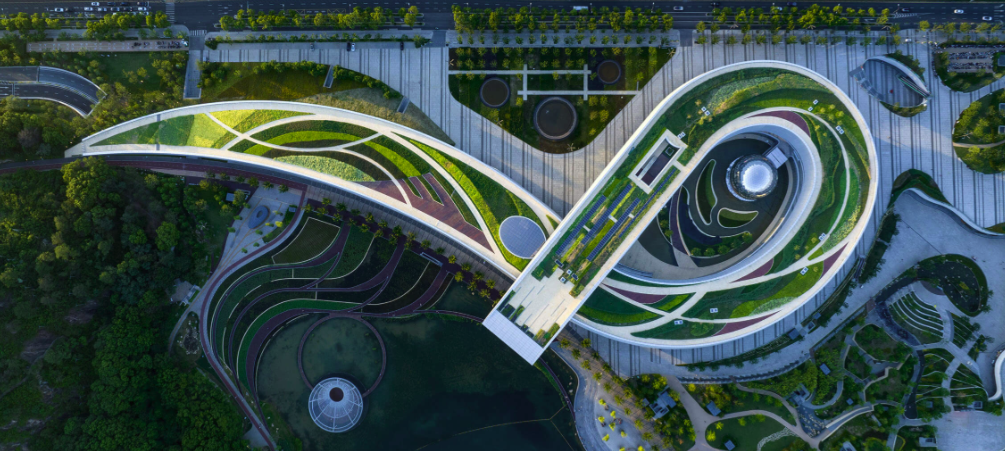
TreeGridTowerZ is a bold Public-Private Partnership designed to transform Ghana's digital landscape, not with steel and concrete, but with living, growing trees that restore natural landscapes while delivering connectivity.
Universal Digital Inclusion
Targeting nationwide land-area coverage as a universal service objective, specifically extending reliable service to the rural and remote areas currently underserved across all 16 regions of Ghana.
Ghana as a Leader in Africa
Positioning Ghana as a strategic leader in universal service coverage, to be the first African nation to achieve a nationwide absolute land-area coverage objective.
Economic Stimulation
Universal coverage is projected to distribute a monthly cash flow of at least 2 billion GH₵ across the country, enabling e-commerce, e-government, and fintech expansion.
State-Supervised Critical Communications
Creating a state-supervised critical communications backbone providing high-assurance data paths for elections, national emergencies, disaster resilience, and secure government communications.
The project aligns with Ghana's Digital Agenda and ICT4AD policy, converting underutilized land into productive infrastructure assets through sustainable innovation, and building a legacy of connectivity, equity, and climate resilience for future generations.
The TreeGridTowerZ Approach
A phased public investment and PPP implementation model turning living trees into certified national telecommunications infrastructure, delivering strong value for money against conventional steel tower alternatives.
How It Works





Aeroponic Cultivation
Indigenous species (African Mahogany, African Teak, Makore) are grown in a Vancouver aeroponic facility into lightweight, transport-ready seedlings, small enough to be carried in a backpack to remote forests.
Bio-Structural Shaping
Trees are guided into structural forms using patented and patent-pending bio-architecture methods. Engineers use Finite Element Method (FEM) voxelation - digitally breaking each tree into thousands of cubic blocks to calculate load capacity and stress.
Network Integration
Antenna panels, Remote Radio Units (RRUs), Baseband Units (BBUs), and microwave backhaul dishes are mounted at the tree apex. Towers are spaced 8 km apart across a national lattice grid targeting nationwide land-area coverage.
Community Deployment
Deployed across all 16 regions via a PPP model. Landowners become co-owners or equity partners, sharing long-term lease revenue from telecom operators, converting underutilized land into productive infrastructure assets.
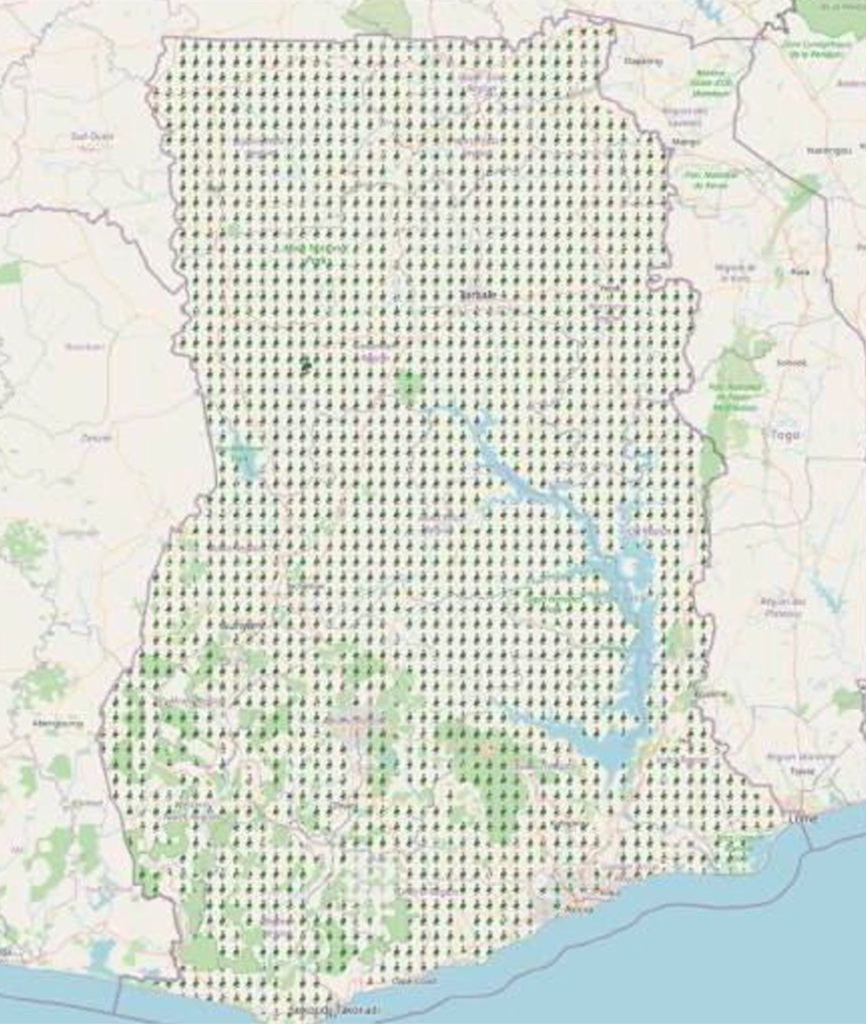
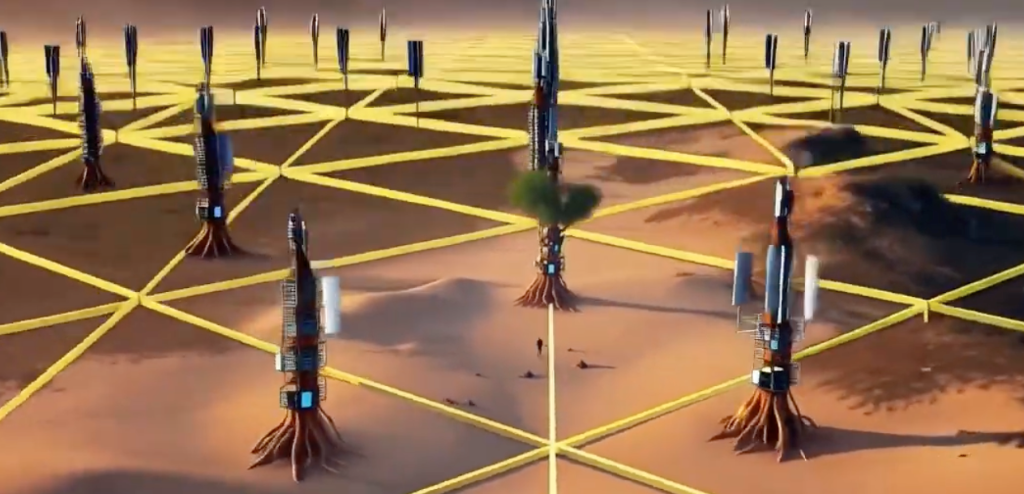
This is what the grid looks like when observed from an elevation of 700km (the last layer of atmosphere before 'outer space' the exosphere). Towers are spaced every 8 km to scale.
When all the towers have become operational, we expect to find 3 types: TYPE R - RETROFITTED NATURAL TOWERS - $1,500 TYPE G - GROWN LIVING TOWERS - $65,000 TYPE T - TRADITIONALLY BUILT TOWERS - $150,000 to $500,000 THE NEXT SLIDES PROVIDE MORE DETAIL
From Pilot to National Mainstay

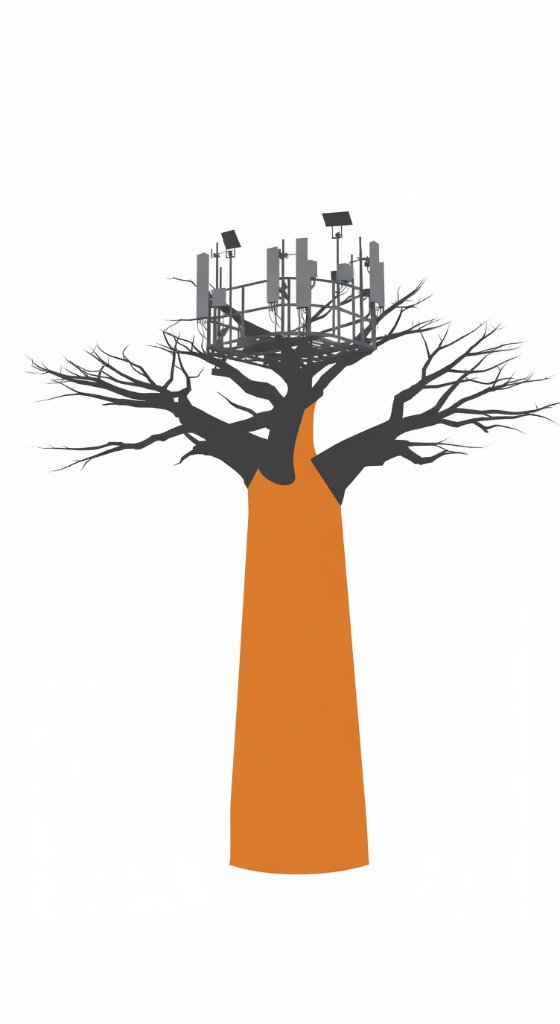
Adansonia Pilot
Low Risk and Immediate start for up to 1/3 of the project's towerz. (In Ghana's far North where communication is most needed)
Utilizing existing Baobab (Adansonia digitata) trees in northern Ghana as 'pre-grown' natural masts. Non-invasive brackets and catenary systems are clamped around trunks - no penetration - delivering immediate connectivity without the multi-year growth wait.
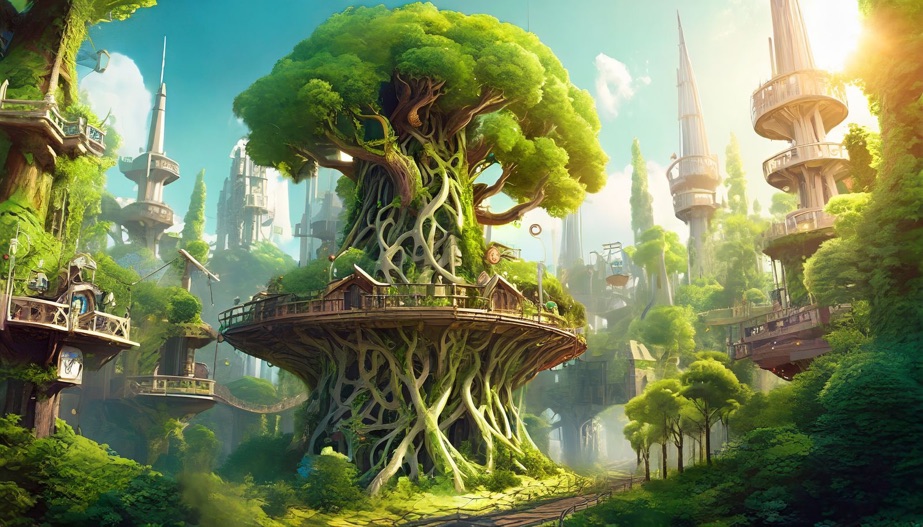
National Mainstay Rollout
Phase 2: Full Lattice Deployment
Progressive regional expansion following a standardized operational blueprint, deploying ~3,500 aeroponically shaped living towers across the 8 km national lattice grid over an 8-year period.
State-Supervised Critical Communications Backbone
Phase 3: State Network Layer
TreeGridNet acts as a wholesale operator, aggregating raw capacity from PPP infrastructure providers and supplying high-assurance data paths for elections, disaster-response networks, and secure government communications.
Multi-Dimensional
National Impact
TreeGridTowerZ extends far beyond telecommunications - it is a living infrastructure that simultaneously advances ecology, economics, sovereignty, and social equity.
across Ghana's entire land area
Bridging the Digital Divide
Seamless 4G/5G coverage across all urban and rural regions - enabling e-commerce, e-government, and mobile banking for every Ghanaian.

Pollinator Lattice
3,500 living towers form a nationwide network of habitat 'stepping stones' for birds, bats, and insects - increasing cocoa, cashew, mango, and shea crop yields.
Community Co-Ownership
Landowners become equity partners - contributing to construction costs in exchange for long-term shares of telecom lease revenue, converting underutilized land into productive infrastructure assets.
Accountability-by-Design
The framework embeds payment-compliance and service-continuity safeguards into the infrastructure architecture - structured default recourse mechanisms with emergency-service continuity provisions.
Ecological Stewardship
Indigenous species sequester carbon as they grow, minimize landscape disruption, and preserve biodiversity - materially lower embodied-carbon profile than conventional steel-and-concrete alternatives.
Fiscal Returns to Ghana
$140M one-time revenue from licensing, permits, and duties. $69M annually recurring from lease revenue shares, corporate taxes, and spectrum fees.
Public-Private Partnership
Architecture
The PPP framework mobilizes private capital for national infrastructure while protecting the public balance sheet - requiring no direct central government capital outlay.
One-Time Government Revenue
$140M
From licensing, building permits, and import duties across a national rollout of 3,500 towers.
Landowners that sign a rezoning agreement can expect
up to ₵150M
This is the revenue that is to be expected from hiring out the top of the tower to telecommunication companies to place their equipment.
A government official explains to villagers in the north how much revenue they can expect from renting out the top of their baobabs. - Explicitly Generated by AI
Government
Plays an enabling, regulatory, and coordinating role - facilitating approvals, spectrum licensing, and permits. Earns $69M+ annually through fees and taxes. Acts under PPP Act 2020 (Act 1039).
Private Sector
Telecom operators and tower companies finance construction and operations. Assume primary construction, technology, and operational risks. Pay lease fees to landowners.
Landowners
Convert underutilized land into productive infrastructure assets. Contribute to construction costs in exchange for long-term revenue shares. Land-backed loans and community crowdfunding options available.
LandShifterZ
Facilitates the entire model - providing landowners with funding options, legal guidance, and access to architectural and botanical consultants. Ensures ecological compliance.
Approximately 250,000 aeroponically grown trees (fifty per tower) are planned over a 3-year period. The Vancouver facility guarantees a consistent supply of specialized, lightweight seedlings portable enough to be carried into the most remote Ghanaian forests. A second facility is planned for Accra to reduce logistics costs and support local horticultural expertise.
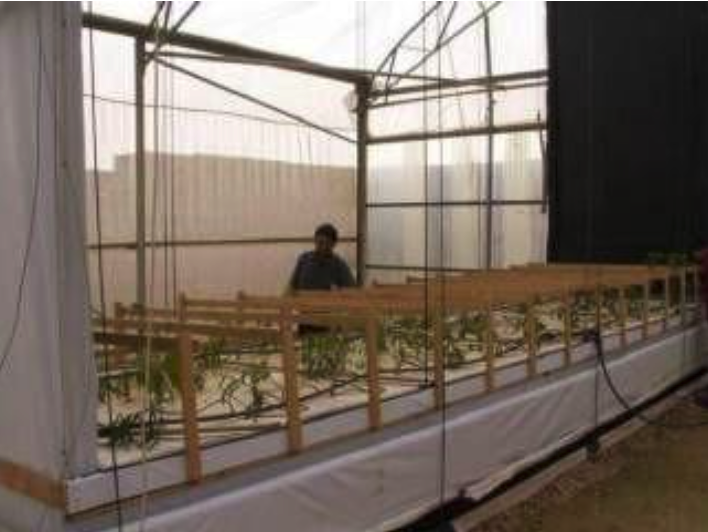

What the facility produces: a compact two-meter aeroponic tree with a six-meter fibrous root system, shown beside a person lying parallel to the root for scale. The long, lightweight root architecture makes these trees transport-ready - small enough to backpack into remote Ghanaian forests yet structurally substantial once established.
Template Shaping Process
From Soft Root to Solid Form
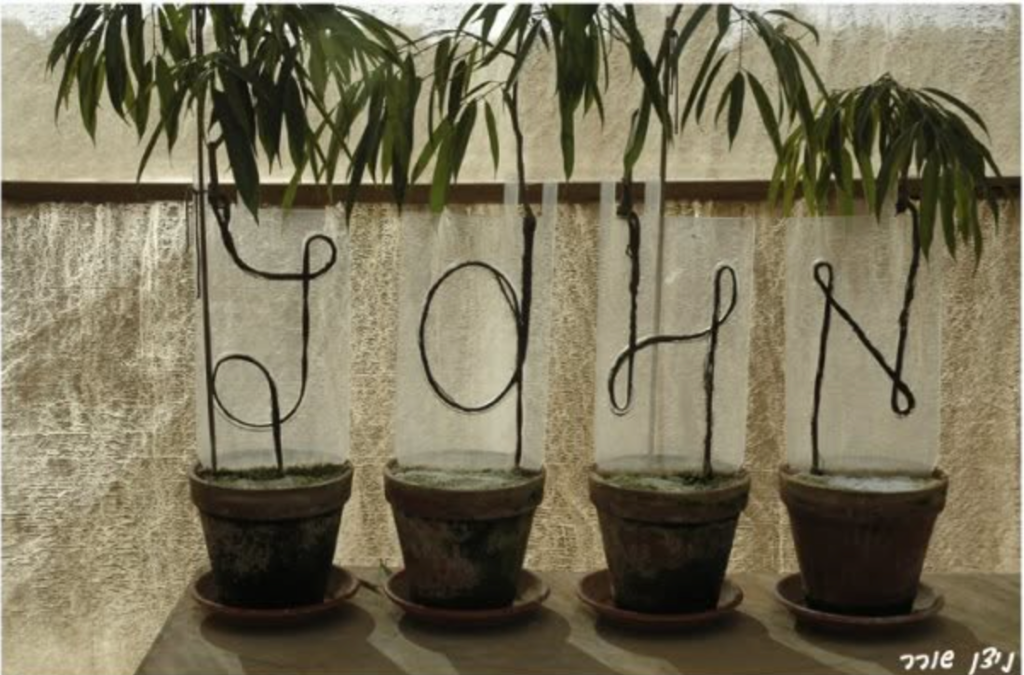
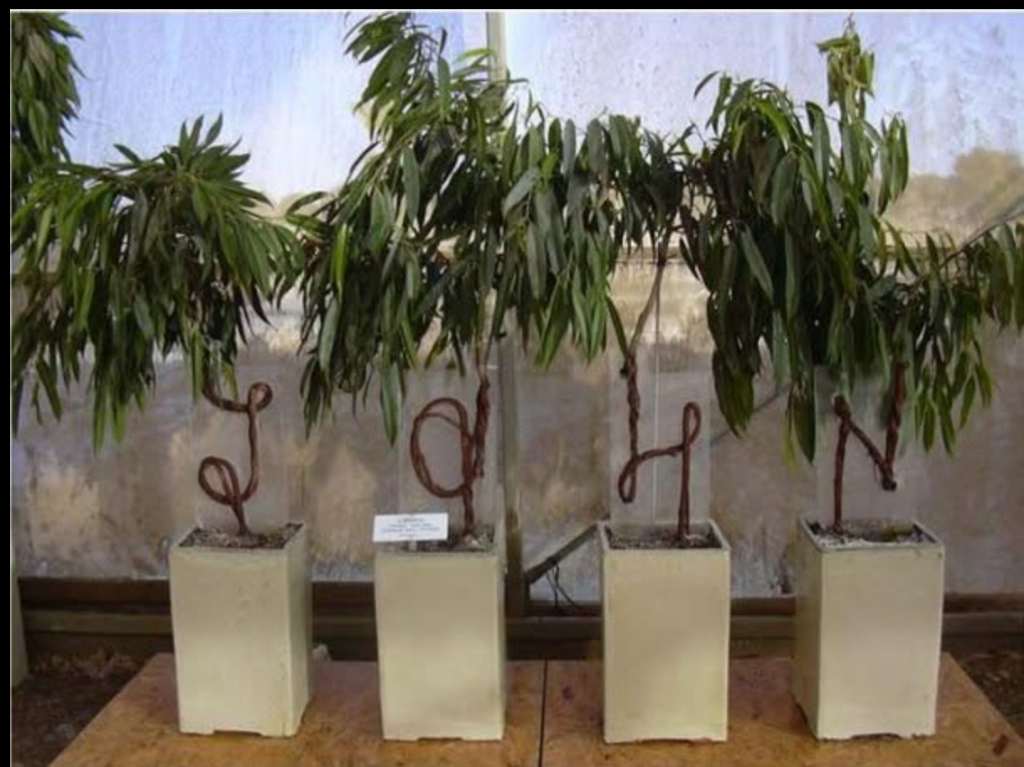
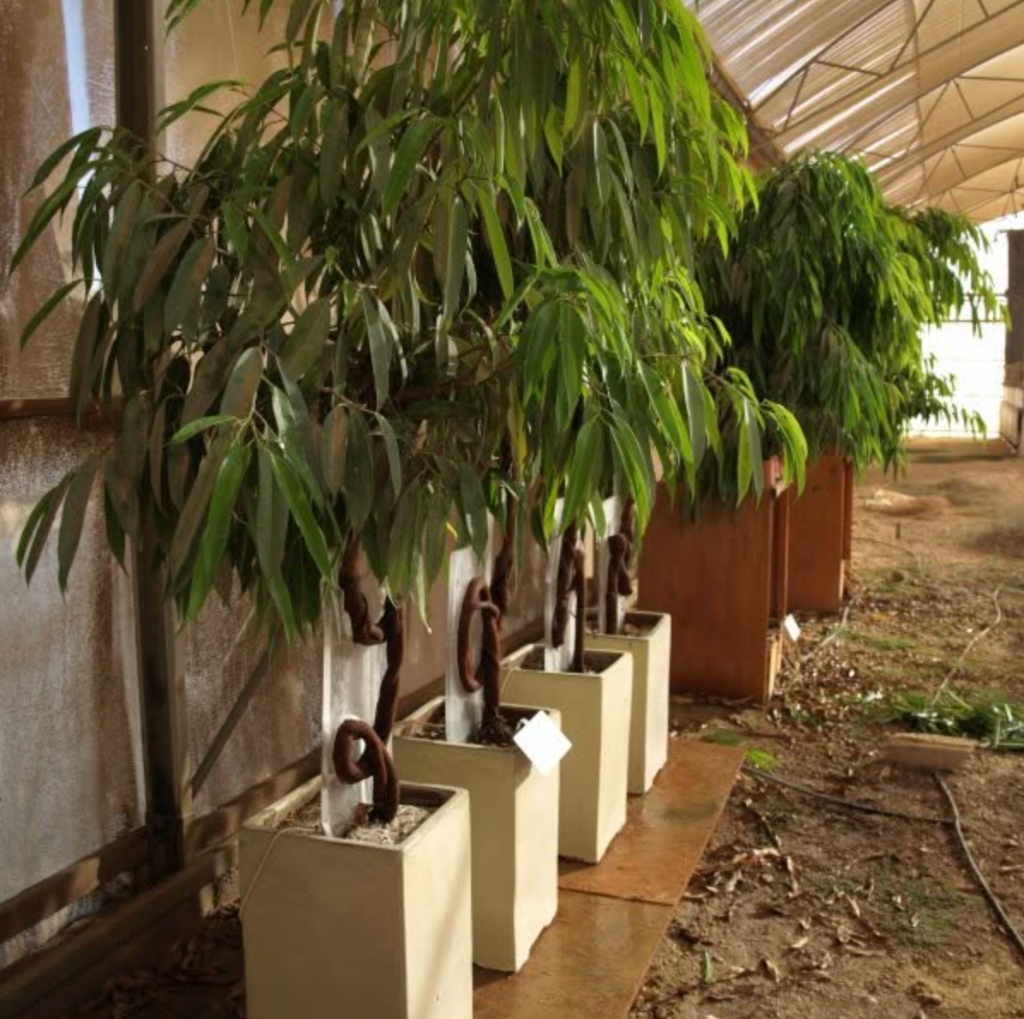
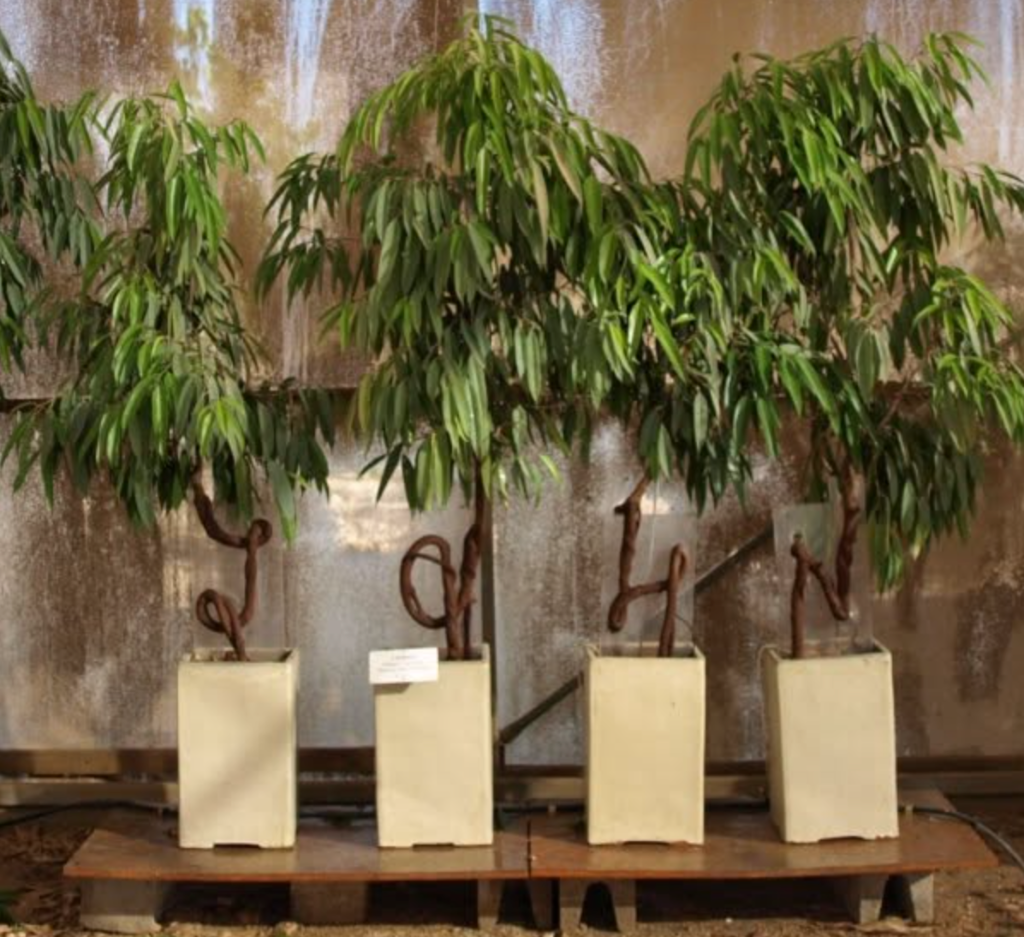
In the example below, the Vancouver facility uses clear plexiglass templates to guide aeroponic seedlings (of the asian tree Ficus longifolia) into precise structural geometries. These letterforms (J-O-H-N) demonstrate how each year the root thickens and hardens, until the template can be removed and the living wood holds its own shape - the same method later scaled up for load-bearing freestanding tower constructs.
Stage 1: Year 0
Root diameter 1mm
Flexible aeroponic seedlings are threaded onto clear plexiglass templates in the Vancouver greenhouse. The trunk is still thin and pliable, easily bent into the desired letterform.
Stage 2: Year 1
Root diameter 8mm
The trunk begins to thicken and lignify, holding the guided curve more firmly against the template while the canopy continues to photosynthesize and feed structural growth.
Stage 3: Year 2
Root diameter 16mm
The woody trunk has solidified into the letterform. Inosculation (natural grafting) fuses crossing segments into a single living structure, while the template that remains as a scaffold is beginning to seem unnecessary.
Stage 4: Year 3
Root diameter 22mm
The trunk (root) is now rigid enough to support its own geometry. The plexiglass template has been removed, leaving a fully integrated, load-bearing living structure - the same principle scaled up for the tower lattice.
Dedication. Expertise. Passion.
A diverse team of leaders in architecture, technology, horticulture, and business development driving this transformative project.

Mitchell Joachim
Project Lead
Renowned for his groundbreaking eco-designs.
View on LinkedIn →
Ezekiel Golan
Chief Technologist
Visionary in aeroponics and network design.
View on LinkedIn →
Mendel Skulski
Chief Botanical Executive
Expert in advanced horticultural systems.
View on LinkedIn →
Prince Edward Carboo
Director, LandShifterZ Ghana
Dynamic entrepreneur and strategic director.
View on LinkedIn →
Ingrid Sanghee Edwards
Director of Art, Branding and Marketing
Creative engine, expressing dedication to cultural transformation.
View on LinkedIn →
Amilcar van der Horst
Top Tier Level Facilitator & Problem Solver
A true World Changer. Multilingual, and globally connected.
View on LinkedIn →Join the Movement
Whether you're a potential partner, investor, community leader, or simply curious about how TreeGridTowerZ can transform connectivity — we'd love to hear from you.
info@landshifterz.com
Amsterdam Office
Vancouver Office
Learn More
Visit our Canadian website for the full project documentation, investor materials, NFT collection, and partnership opportunities.
Visit LandShifterZDesigns.comProject Gallery
Visual impressions of the living tower concept - from the Baobab pilots of the far North to the nationwide lattice grid vision. Hover any AI-generated image to reveal its badge.