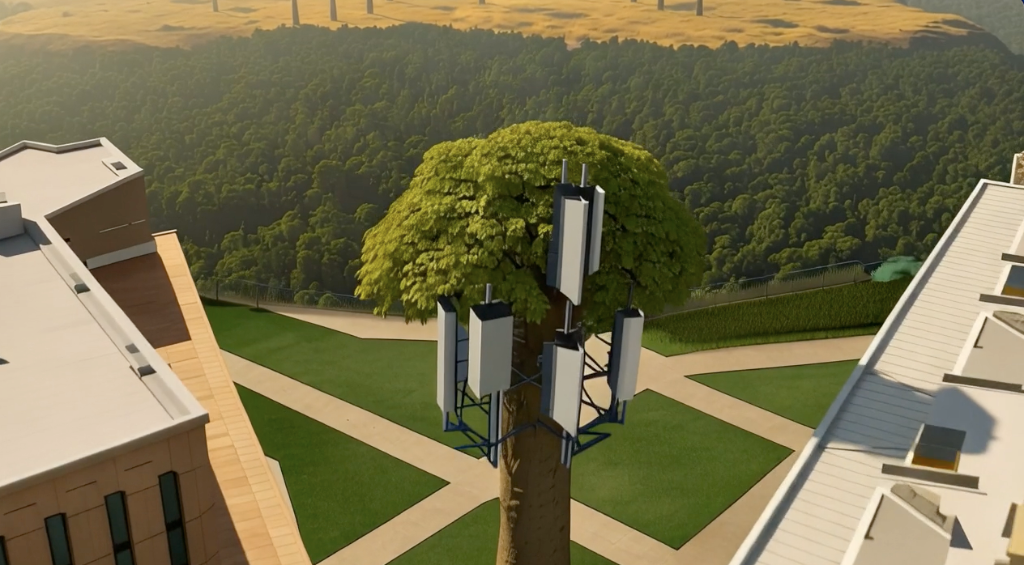
National Mainstay Rollout
Full Lattice Deployment: Progressive regional expansion deploying ~3,500 aeroponically shaped living towers across the 8 km national lattice grid - targeting Ghana's universal service coverage objective.
Overview
Phase 2 scales the proven Adansonia Pilot model to nationwide deployment, utilizing aeroponically shaped trees cultivated at the Vancouver facility. This phase represents the core infrastructure rollout, deploying approximately 3,500 living towers across Ghana's 16 administrative regions over an 4-year period. The national lattice is designed with 8 km grid spacing to ensure 100% cellular coverage while minimizing redundancy.
Deployment Strategy
Regional rollout follows a phased approach, prioritizing high-population density areas, underserved rural zones, and strategic corridors for digital economic development.
Phase 2A (Years 1–3)
Deploy ~1,000 towers across 8 regions (Greater Accra, Ashanti, Central, Eastern, Western, Volta, Northern, Upper East).
PHASE 2B (YEARS 2-3)
Deploy ~1,300 towers across remaining regions and infill areas for optimal coverage.
PHASE 2C (YEARS 3-4)
Deploy final ~1,200 towers for full 100% coverage and network redundancy across all regions.
Operational Activation
Towers become operational gradually, from Year 1 through Year 8, as trees mature and equipment is installed.
Infrastructure Specifications
Tower Design
Aeroponically shaped trees (Khaya senegalensis, Milicia excelsa, Tieghemella heckelii) with bio-structural guidance into tripod, lattice, or column forms capable of supporting 200–500 kg telecom payloads at 15–30 m heights.
Network Coverage
8 km lattice spacing with multi-sector antenna arrays supporting 4G LTE and 5G NR. Each tower hosts Remote Radio Units (RRUs), Baseband Units (BBUs), and microwave backhaul capacity.
Power & Backhaul
Distributed power systems combining buried cable connections, on-site solar arrays, and battery backup. Backhaul via microwave dishes and fiber optic links to regional hubs.
Supply Chain & Operations
- • Cultivation: Vancouver aeroponic facility produces 500–700 mature trees per year for national deployment.
- • Logistics: Trees are packaged for air or sea freight and transported to regional distribution hubs in Accra, Kumasi, and Takoradi.
- • Installation: Regional teams handle site preparation, tree planting, clamping system installation, and telecom equipment integration.
- • Monitoring: Real-time telemetry via embedded dendrometers, strain gauges, and wireless sensors tracks tree health and structural integrity 24/7.
- • Maintenance: Quarterly arborist inspections and annual equipment servicing ensure continuous operation and tree longevity.
PPP Framework
Government Role: Regulatory oversight, frequency spectrum allocation, and revenue collection (licensing fees, lease revenue share, taxes).
Private Sector Role: Infrastructure development, telecom operator leasing, equipment maintenance, and network operations.
Landowner Role: Land provision and co-ownership equity shares, receiving long-term lease revenue from telecom operators.
Expected Impact
- ✓ 100% cellular coverage across Ghana (4G/5G ready)
- ✓ Digital inclusion for 20+ million underserved citizens
- ✓ $140M in one-time government revenue (licensing, permits, duties)
- ✓ $69M+ annual recurring government revenue
- ✓ 15,000+ jobs in construction, maintenance, and operations
- ✓ 3,500 tonnes CO₂ sequestration per decade (ecosystem services)
- ✓ Enhanced biodiversity via pollinator lattice and mycorrhizal networks
Transition to Phase 3
Upon completion of Phase 2, the TreeGridTowerZ infrastructure becomes eligible for transition to Phase 3: Sovereign Backbone development. At this stage, the government can establish TreeGridNet as a wholesale operator, purchasing raw capacity from private operators and providing ultra-redundant data paths for government communications, elections, disaster response, and critical infrastructure.