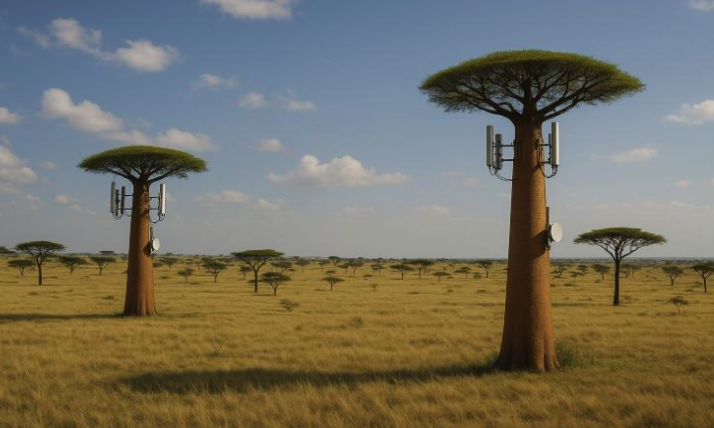
Adansonia Pilot
Phase 1 - Proof of Concept: Utilizing existing Baobab trees in northern Ghana as pre-grown natural masts to demonstrate technical feasibility, regulatory pathways, and value-for-money foundations for national scaling.
Overview
The Adansonia Pilot represents Phase 1 of the TreeGridTowerZ project, leveraging existing Baobab (Adansonia digitata) trees across northern Ghana as natural telecommunications masts. Non-invasive brackets and catenary systems are clamped around trunks - with no penetration required - delivering immediate 4G and 5G connectivity without the 1 year growth wait associated with aeroponically cultivated trees.
Key Objectives
- • Establish proof of concept for living tree telecommunications infrastructure
- • Demonstrate regulatory compliance and technical feasibility
- • Build government and telecom operator confidence in the model
- • Generate early revenue and operational data for national scaling
- • Establish operational protocols for tree maintenance and equipment management
Scope & Scale
1,000 towers will cover the entire north including key population centers and regional connectivity gaps.
Technical Implementation
Non-Invasive Clamping: Stainless steel brackets and catenary systems are securely clamped around the tree trunk at 15–30 m height, requiring no drilling or penetration into living wood.
Antenna & Equipment Installation: Remote Radio Units (RRUs), Baseband Units (BBUs), sector antenna panels, and microwave backhaul dishes are mounted on the clamped structure at the tree apex.
Power: Power is delivered via cable when available or on-site solar with battery backup plus wind microturbines where weather is conducive to such.
Timeline & Milestones
- • Months 1-6: Advertising and outreach effort to begin negotiations for all 1,000 Adansonia towers.
- • Months 7-24: The project objective is to finalize all rezoning agreements and deploy within this period.
Risk Mitigation
Tree Health Monitoring
Continuous dendrometer sensors and periodic arborist assessments ensure tree health is maintained throughout the project duration.
EPA Monitoring
Graduate students of zoology (ideally keeping a ratio of 3 to 1 between students of entomology to those of vertebrate zoology) follow up and compare the health and welfare of animals living on telecommunications-mounted megafauna to those living on natural, undisturbed trees.
Equipment Safety
All clamping systems are engineered and certified for structural load-bearing; regular inspections ensure compliance with safety standards.
Expected Outcomes
Upon successful completion of the Adansonia Pilot, the project will have demonstrated:
- ✓ Technical feasibility of living tree telecommunications infrastructure
- ✓ Regulatory pathways for certification under Ghanaian telecommunications standards
- ✓ Operational protocols for tree maintenance, equipment servicing, and 24/7 network monitoring
- ✓ Government revenue generation models and PPP partnership effectiveness
- ✓ Landowner co-ownership and equity-sharing mechanisms
- ✓ Environmental and ecological integration metrics
This foundation will enable rapid scaling to the National Mainstay Rollout phase, deploying ~2,500 aeroponically shaped living towers across Ghana's [ 8 Km ]n lattice grid.
Before the Pilot
Call for Innovation: Type R — Retrofitted Natural Towers
Before the Adansonia Pilot enters field deployment, the project will run a focused Call for Innovation for practical Type R TreeGridTowerZ designs — retrofitted natural towers using existing mature megaflora as living vertical assets for telecommunications infrastructure.
The Core Bioretrofit Challenge
How can telecom equipment be mounted on living megaflora without drilling, girdling, poisoning, destabilizing, or otherwise harming the tree?
Who Is Invited
Network builders, engineers, arborists, fabricators, infrastructure designers, and related technical teams are invited to design the highest-quality bioretrofit integration systems for mature living trees within the TreeGridTowerZ grid.
Under the TreeGridTowerZ model, network builders do not need to scramble for scattered tower sites. The grid provides a coherent national deployment logic. Their opportunity is to solve a different and more valuable problem: how telecom equipment should interface safely, reversibly, and durably with living megaflora.
What Designs Must Address
That means addressing mounting, load distribution, wind behavior, equipment access, maintenance, ventilation, growth allowance, moisture control, inspection, reversibility, and long-term tree health. The best designs will help define how Type R towers are deployed during the Adansonia stage and later adapted to other regions, species, and national networks.
The opportunity is not merely to supply equipment for one pilot. Participants may create patentable bioretrofit designs for an emerging global category: living-tree infrastructure interfaces — valuable in any country that adopts the TreeGridTowerZ model.
Support from the TreeGridTowerZ Team
The TreeGridTowerZ team is particularly well-qualified to help participants refine concepts, combining experience in patenting, living architecture, horticulture, and large-scale horticultural systems.
This support can help participants clarify protectable features, strengthen visual and technical presentation, and frame inventions for broader use — offered to strengthen the project and increase the incentive for serious participation.
No Hidden Costs.
TreeGridTowerZ does not seek a percentage of participants' patents. The purpose is to help good ideas become clearer, more protectable, and more useful to the Adansonia stage.
Early submission is encouraged — the sooner a promising concept is submitted, the sooner the team can help identify its strongest design features.
Starter Taxonomy
The following starter taxonomy is offered not as a constraint, but as an accelerator — giving participants immediate engineering archetypes from which to begin.
* This call is not for the design of the entire TreeGridTowerZ network. It serves the Adansonia stage specifically. The network grid provides the larger coverage framework; this call focuses on the living-node interface.
Reach out via the contact section to begin your submission.