The Political Case
How TreeGridTowerZ aligns with Ghana's national development agenda, regulatory frameworks, and public-private partnership legislation.
Ghana's Land Sovereignty & Governance Framework
Understanding Ghana's constitutional land framework is foundational to the TreeGridTowerZ project. The deployment of 3,500 living tree towers across the country requires navigating a well-defined hierarchy of land authority - from constitutional sovereignty down to local zoning approvals.
The Constitutional Premise
Under Ghana's Constitution, sovereignty over all land ultimately rests with the state. Land is held in trust for the people. Private and communal ownership exists, but always subject to the overarching authority of the state. This constitutional principle gives the government clear legal standing to facilitate and mandate national infrastructure projects like TreeGridTowerZ.
The Lands Commission
The Lands Commission is the key institution managing land administration in Ghana. It oversees official land records, registration, and title deeds. Every tower site in the TreeGridTowerZ network must be verified through the Lands Commission to ensure clean title, prevent disputes, and protect both the project and landowner investments.
Zoning & Rezoning
Zoning in Ghana determines what land can be used for - residential, commercial, agricultural, etc. Where tower sites require rezoning, the process involves community consultations, environmental assessments, and approval by appropriate planning authorities, ensuring any change aligns with national policy and local needs.
The Sovereignty Promise
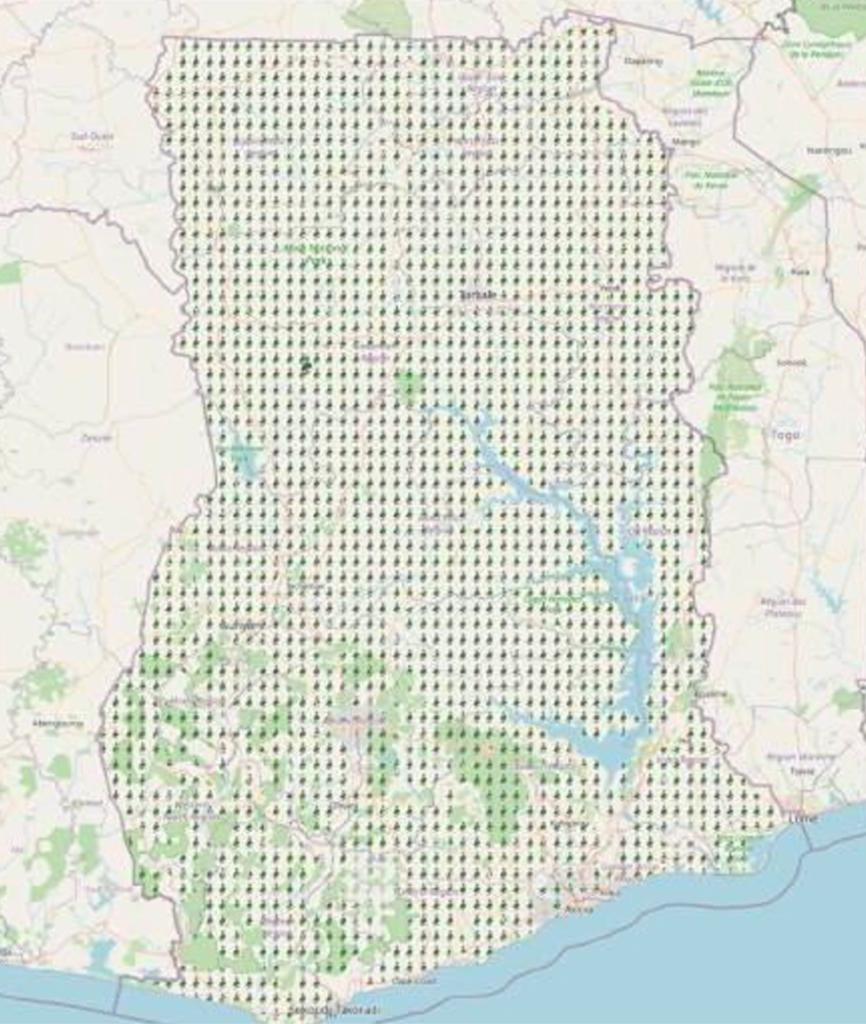
ONLY the State can guarantee full national mobile coverage. Telecommunications companies are exceptional at building networks, but no single operator can, on its own, manifest guaranteed national land coverage as a unified, fully functional system. The state has the authority to define the entire territory as a single integrated system and declare a coverage geometry that guarantees national coverage (rather than having it result from fragmented site-by-site assembly - which is what has been the telco-led process until now). Asimple but powerful idea: Overlaying an 8km lattice across the country that defines placement for elevated communications nodes at grid intersections creates a system designed for full national coverage guaranteed, which is high redundancy, scalable, and future-friendly. This grid logic is illustrated in the national coverage map shown in the next card
Idealized Grid Map
A Governance First
In the current telecom world, the major hidden cost is not radio equipment - it's site acquisition complexity:
- Hunting for rooftops and comm islands
- Negotiating with thousands of owners
- Handling disputes and delays
- And losing time to zoning and permissions churn
This approach flips that reality. It is built on the premise that the state (Ghana), using its sovereignty, can declare a national node allocation policy which says:
Strategic Alignment
Because land sovereignty ultimately resides with the state and the Constitution mandates it be held in trust for the people, a nationally-gazetted infrastructure programme such as TreeGridTowerZ - delivering universal connectivity - sits squarely within the government's constitutional mandate. This provides a strong legal and political basis for expedited land access, rezoning approvals, and long-term tenure security for tower sites across all 16 regions.

Contingency Plans: Protecting Government & Tower Manager Interests
To ensure financial accountability and infrastructure protection, the TreeGridTowerZ project includes robust contingency mechanisms for handling telecommunications company defaults on license fees and tower maintenance payments.
Plan 1: Government Default-Management Framework - License Fee Defaults
Licensing Mechanism
The system employs a time-based cryptographic licensing mechanism. If contractual obligations are unmet, the cryptographic key is not reissued, preventing operational access until compliance is restored. This ensures continuity for critical services while maintaining strict adherence to agreements.
Notification System
The system includes a proactive notification framework. Automated warnings are issued to the operator 60, 30, 14, and 7 days prior to any license expiration or suspension, offering ample time for resolution and ensuring transparency in compliance.
Plan 2: Tower Manager Recourse - Maintenance & Lease Defaults
Notice & Grace Period
Tower Managers issue formal written notice outlining the default amount and payment terms. A 21-day grace period allows TelCos to resolve the issue. Weekly reminders are sent, and the Ministry of Communications is notified of potential enforcement actions.
Enforcement Action: Remote Configuration Suspension
Tower Managers can temporarily suspend equipment functionality via remote configuration-only after multiple warnings and regulatory approval, and only in a way that is stipulated by the contract. If any unauthorized physical intervention or tampering occurs, it triggers a breach alert, in which case, local authorities are notified for on-site verification and enforcement. This fallback is the standard legal, regulated escalation route.
Restoration of Equipment & Service
Upon full payment confirmation, the Tower Manager reconnects equipment within 24 hours and issues a restoration notice to both the TelCo and Ministry.
General Provisions & Dispute Resolution
Arbitration & Mediation
Any disputes arising from these contingency plans are subject to arbitration under Ghanaian law, with the Ministry of Communications acting as the primary mediator.
Force Majeure
In the event of force majeure (natural disasters, war, etc.), both plans are temporarily suspended and TelCos are granted extended grace periods until the issue is resolved.
Notice Requirements
All formal notices are sent via electronic mail with confirmation of receipt required. Notices serve as courtesy notifications but do not condition enforcement actions.