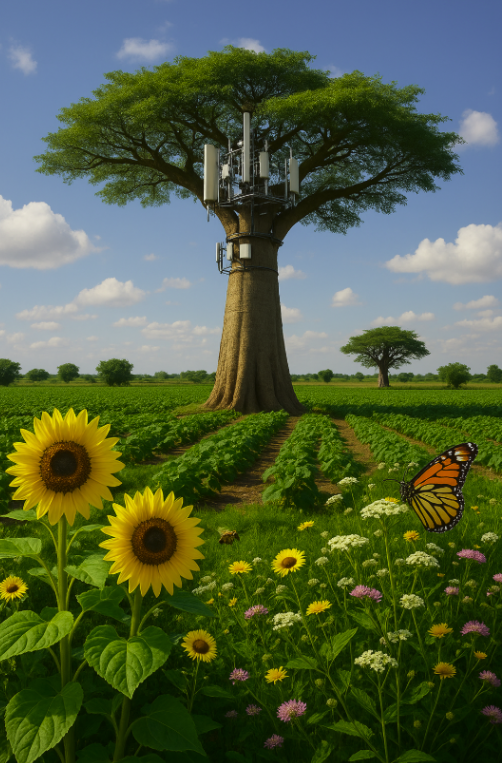
Pollinator Lattice & Agricultural Prosperity
How the TreeGridTowerZ nationwide lattice functions as a resilient pollinator network - strengthening food security and rural livelihoods across Ghana.
Purpose
This appendix outlines how the mature TreeGridTowerZ network - a nationwide lattice of living and engineered tree-towers spaced roughly every 8 km - can act not only as a communications grid but also as a pollinator lattice: a resilient, many-path network of habitats and stepping stones for pollinating insects, bats and birds. By strengthening pollination services across rural landscapes, this lattice has the potential to raise agricultural output and rural incomes, especially in smallholder tree-crop and mixed-farming systems.
From Pollinator Corridors to a Pollinator Lattice
Traditional conservation planning often focuses on linear corridors - strips of habitat that link two larger patches. In contrast, the fully deployed TreeGridTowerZ system would create a two-dimensional lattice of pollinator habitat/feeding nodes, each centred on a TreeGridTowerZ structure and its surrounding micro-landscape.
- Each site can support flowering trees, shrubs and understorey plants attractive to diverse pollinators (bees, flies, butterflies, moths, beetles, bats and nectar-feeding birds).
- Towers are deliberately distributed as a grid, so that most agricultural land lies within a few kilometres of multiple nodes rather than a single corridor.
- This creates many alternative routes for pollinators to move across the landscape; if one node or local habitat patch is degraded, others can still support movement and genetic exchange.
International assessments show that about three-quarters of global crop species depend to some extent on animal pollination, and roughly one-third of crop production volume benefits directly from pollinators. A lattice that increases pollinator abundance and connectivity therefore has direct implications for food security and farm incomes.
Expected Agricultural & Rural Livelihood Benefits
Higher Yields & Better Quality in Pollinator-Dependent Crops
- Many high-value fruit and nut crops (mango, cashew, citrus and shea) show strong yield and quality responses to abundant, diverse pollinators; studies report large increases in fruit set and yield when flowers are accessible to wild insect visitors.
- By increasing local pollinator populations and providing safe movement routes between farms and natural vegetation, TreeGridTowerZ nodes can help close pollination deficits that currently limit yields in such crops.
Support for Cocoa and Other Tree-Crop Systems
- Evidence from Ghana and elsewhere indicates that insufficient natural pollination is one contributor to the cocoa yield gap, prompting programmes such as cocoa hand-pollination to compensate.
- Strategically designed TreeGridTowerZ plantings - including shade trees, flowering understorey plants and conserved riparian strips near towers - can improve habitat for the tiny insects and invertebrates that pollinate cocoa and companion crops, potentially reducing the need for costly manual pollination over time.
Stability and Resilience of Production
- Global analyses show a positive relationship between pollinator abundance and crop yield across many crop types and climates, with management practices modulating the strength of the effect.
- A lattice of habitat nodes reduces the risk that localised pesticide misuse, land-clearing or extreme weather will collapse pollination services over large areas, thus stabilising yields year-to-year.
Income Diversification & Ecosystem-Service Markets
- TreeGridTowerZ nodes can host additional income-generating activities aligned with pollinator conservation: beekeeping, production of pollinator-friendly seed mixes, or agritourism centred on biodiversity.
- Over time, Ghana may be able to quantify and monetise the pollination and biodiversity services provided by the lattice within emerging green-finance or ecosystem-service frameworks, bringing additional revenue streams into PPP structures.